
Why Does AI Struggle With Hands?
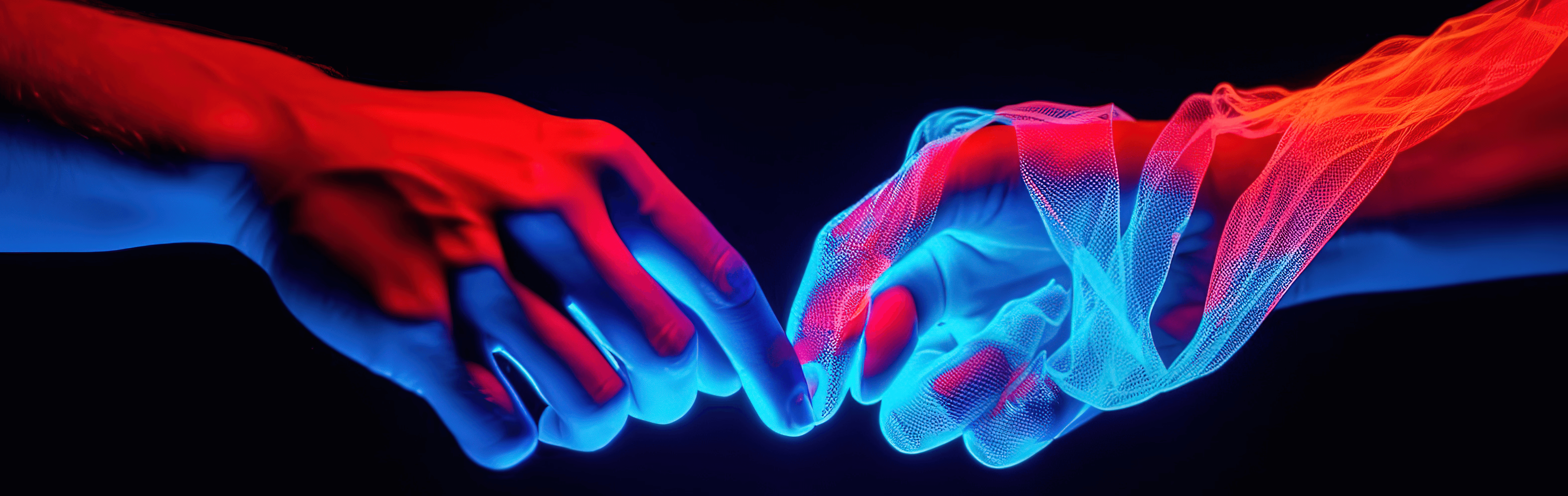
It is a rite of passage for any art student: the charcoal-smudged desk, the cramping wrist, and the maddening attempt to sketch one’s own left hand. To the untrained eye, a hand is a simple tool; to the artist, it is a nightmare of overlapping joints, foreshortened digits, and a thumb that stubbornly juts out like a broken bone. We assume we know what a hand looks like until we are forced to look closely. Today, artificial intelligence is failing that same high-school art assignment.
The Limitations of AI Hands
To artificial intelligence, a hand is just a cluster of textures. When it tries to recreate that cluster, it often guesses wrong, sprouting a thumb from a middle finger because it saw something similar in a blurry photo.
To a human, a fist, a peace sign, and a pointing finger are all different states of the same object. However, most generative models lack an internal 3D physics engine. Then there’s the annotation gap. Most training datasets are poorly labeled regarding fine-motor details. A photo might be captioned "man drinking tea," but it rarely specifies "left hand in a lateral grasp with three fingers occluded."
Without these explicit labels, the AI treats a partially shown hand as a complete hand template This leads to several recurring failures with AI fingers:
The model merges two different hand poses it saw during training, resulting in a six- or seven-fingered hybrid.
Fingers bend at impossible angles because the model is tracking the wiggly line of the skin rather than the rigid constraints of the phalanges.
Because the AI doesn't distinguish between the hand and the object it is holding, the two often fuse at a molecular level in the final render.
Uncanny Valley
For decades, we have understood that the sight of something masquerading as human but falling just short of the mark triggers a profound sense of unease. This is known as uncanny valley, a psychological phenomenon first coined in the 1970s.
When we encounter something that looks almost human but contains subtle wrongness, our brains register a discord between what we expect and what we perceive. It's the same instinctive wariness that might have once helped our ancestors identify illness or death in others, now activated by entities that blur the line between the familiar and the foreign.
This is particularly pronounced with AI generated hands. When these models create images of people, they often nail the broad strokes but falter on the intricate details that our brains have been trained since infancy to recognize as human. So when AI hands have six fingers, or joints that bend impossibly, it creates precisely the kind of almost right but fundamentally wrong feeling of uncanny valley.
Fixing AI Hand Fails
If the first generation of AI was like a student trying to draw from a blurry memory, the new wave of technology is finally giving the machine a set of blueprints. Engineers realized that they couldn't just keep feeding the AI more photos; they had to teach it how a hand actually works.
Giving the AI a Skeleton
By giving the AI a bone structure to follow, you're essentially saying: here is exactly where the knuckles and joints are, now just fill in the skin and lighting. Because the AI is following a brief, it no longer has to guess where a thumb ends and a palm begins. This backbone prevents the AI from hallucinating extra digits because it has a rigid frame to stick to.
Adding Synthetic Data
Instead of just scanning messy, blurry photos from the internet where hands are often hidden or out of focus, researchers are now using synthetic data, which is basically a training simulator. Instead of using a photo of a real person, engineers create a digital environment where they generate data from scratch.
To create this perfect synthetic data, engineers use hyper-realistic 3D models: the same kind you see in modern video games or blockbuster movies. With a 3D model, every single joint, knuckle, and fingernail is digitally tagged. This way, AI is being told exactly what it’s looking at with 100% accuracy.
Plus, because these are 3D models, the AI can essentially walk around the hand. It can see the skeletal structure from the top, bottom, and side all at once. It will learn that even if a finger is hidden behind a palm, the bone still exists in that 3D space.
An Industry Shift: Collecting Quality Training Data
Tech companies have realized that simply scraping billions of random, blurry images from the internet is no longer enough. To reach professional-grade realism, they need high-quality, human-verified data, and they are willing to pay for it.
This has led to a surge in custom briefs and specialized content projects. When an AI learns from a custom brief where a human photographer has captured a hand from twenty different angles with perfect lighting, it is learning in-depth truths about the subject. This leads to better, more realistic renders. But that’s not all.
Companies are now commissioning specific sets of imagery to ensure their models can handle edge cases, like a hand performing surgery, playing a piano, or holding a very specific type of consumer product. By labeling exactly where the thumb is or how the skin folds during a specific movement, creators are helping the machine move into true anatomical understanding.
So, why can't AI draw hands? Because most models still don’t understand hands as 3D structures, they predict pixels from messy, incomplete examples. What’s changing is that companies are moving away from random scraped images and investing in cleaner, more purposed training data. This won’t make the errors vanish overnight, but it is a real shift towards intentional examples.


Why does AI have a hard time making hands?
What is AI's biggest weakness?
Does this hand problem explain why AI struggles with other details, like teeth or pupils?
Is it harder for AI to render hands in videos compared to a static photo?
Why do AI hands have six fingers?